Declining light output raises the cost of maintaining a greenhouse lighting target because every fixture delivers fewer µmol per joule of electricity as it ages, so growers either pay more for energy to hold PPFD or accept lower yields. The longer a fixture runs without correction, the higher the real cost per delivered µmol becomes.
The size of the effect depends on LED quality, operating temperature, and how strictly a crop such as tomato, cucumber, or lettuce depends on a stable daily light integral. The questions below show how to quantify the drift, compare compensation options, and decide when replacement is cheaper.
How does light decay change the real cost per µmol?
Light decay raises the real cost per µmol because electricity use stays roughly constant while delivered photons fall. If a fixture drops from 100% to 90% of its original output (L90), each µmol costs about 11% more in energy than at installation, and the gap widens as depreciation continues.
Cost per µmol combines purchase price, energy, and maintenance, divided by the total photons the fixture delivers over its life. Most horticultural LED lumen maintenance ratings, such as L90 or L80, describe the hours until output falls to 90% or 80% of the initial value. These ratings are useful, but they are measured under defined conditions. In a warm, humid greenhouse, actual decline can differ from datasheet figures.
Growers should therefore track cost per delivered µmol, not cost per installed fixture. A cheaper fixture with faster depreciation can end up more expensive per µmol than a premium fixture that holds its output longer.
What does lost light output cost in crop yield?
Lost light output reduces yield roughly in proportion to the drop in daily light integral, especially in winter when supplemental lighting supplies most of the light. A sustained PPFD decline below the target means fewer photons per plant, slower growth, and less harvestable product per square meter.
The relationship is rarely perfectly linear, and it varies by crop and season. Research and industry experience show that fruiting vegetables such as tomato and cucumber respond strongly to additional light in low-light months, which is typical in Canada, the northern US, and Scandinavia. That means PPFD decline over time hurts most exactly when lighting matters most.
To estimate the cost, multiply the percentage of lost light by the yield sensitivity of your crop and the value of the lost production. Even a modest shortfall can outweigh the energy savings of not compensating, because harvest value per square meter in high-wire crops is typically far greater than the electricity cost of the lost light.
Should growers compensate by increasing power or adding fixtures?
Growers should usually compensate by raising dimming levels first, if headroom exists, and add fixtures only when the lighting design cannot reach the target any other way. Increasing power is fast and has no capital cost, but it raises energy consumption and can speed up further decline.
Each route has trade-offs:
- Raising power: No capital outlay, but more kWh per delivered µmol, higher driver and LED temperatures, and potentially faster depreciation.
- Adding fixtures: Restores the target without pushing existing units harder and improves uniformity, but requires investment, grid capacity, and shading considerations.
The practical approach is to design the original installation with deliberate headroom, so the system starts below full power and can be stepped up as output declines. That keeps the greenhouse lighting target stable over several years without overspending on day one.
Which factors accelerate LED light output decline in greenhouses?
Heat, humidity, and drive current are the main factors that accelerate LED light output depreciation in greenhouses. Poor thermal management and aggressive operation shorten the time to L90 and L80, while condensation, dust, and chemical exposure add optical losses on top of true LED degradation.
Operating conditions inside the fixture
Junction temperature is the dominant driver. Fixtures running hot because of high ambient temperature, limited airflow, or high drive current lose lumen maintenance faster. Running at full output for long photoperiods every day compounds this effect.
Greenhouse environment and maintenance
Humidity and condensation can attack housings, seals, and optics. Crop protection sprays, dust, and algae or mineral deposits on lenses reduce the light reaching the canopy even when the LEDs themselves are healthy. Regular cleaning prevents this optical loss from being mistaken for permanent decline.
How can maintenance costs be forecast and controlled?
Maintenance costs can be forecast by combining the rated L90 or L80 lifetime with measured PPFD at canopy level and planned operating hours. Controlling them means measuring regularly, scheduling cleaning, and setting a replacement or compensation threshold before output drops below the crop’s target.
A workable routine includes:
- Record baseline PPFD at defined measurement points after commissioning.
- Re-measure at least once per season, using the same points and conditions.
- Compare results to the rated depreciation curve and separate optical soiling from true LED decline.
- Budget dimming headroom, cleaning, and component replacement for the coming years.
- Set a trigger, such as a defined percentage below target, that prompts action.
Treating greenhouse lighting maintenance cost as a planned line item, not a surprise, keeps energy and labor spending predictable and protects the crop plan.
When does replacing fixtures cost less than compensating?
Replacing fixtures costs less than compensating when the extra energy, added fixtures, and lost yield from declining output exceed the annualized cost of new, more efficient LEDs. This usually happens once output approaches L80 or when newer fixtures deliver clearly better µmol per joule.
Compare the two paths over the same period. For compensation, add the extra electricity, any additional fixtures, and residual yield loss. For replacement, add the investment, installation, and downtime, then subtract the energy saved by higher efficacy. Because horticultural LED efficacy has improved steadily over the years, a replacement in 2026 may deliver the same PPFD at noticeably lower greenhouse lighting energy cost than the original installation.
Also weigh uniformity. If decline varies strongly between fixtures, some zones may fall behind others, and targeted replacement of the worst-performing units can be more economical than a full retrofit.
How DLI Helps with Declining Light Output
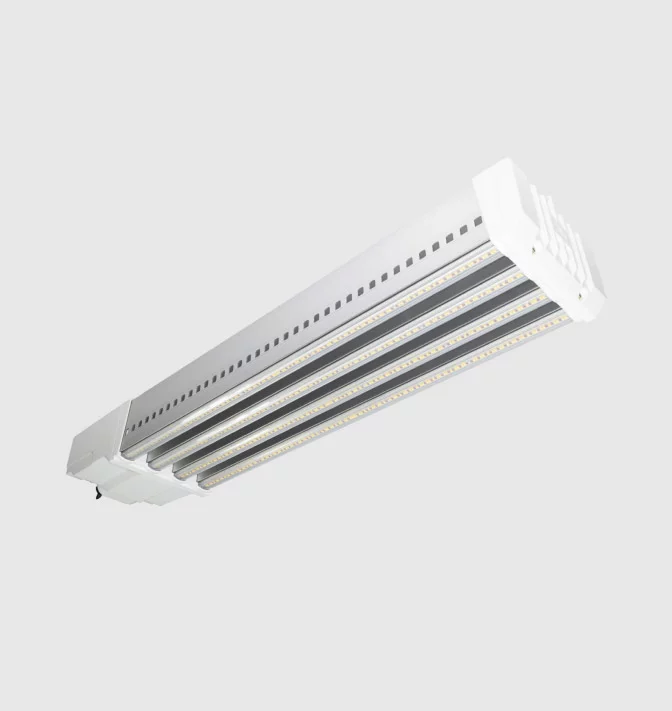
Dutch Lighting Innovations (DLI) is an independent Dutch specialist in horticultural LED lighting, and we design systems so that the lighting target stays achievable as fixtures age. Our approach combines crop-specific design with ongoing performance follow-up.
- Crop-specific design with headroom: We configure lighting around your crop and cultivation strategy, so dimming reserve is built in from the start. See our LED lighting products for the available range.
- Energy-efficient LED technology: High-efficacy fixtures reduce the energy cost per delivered µmol across the lifetime.
- Long-term partnership: We stay involved throughout the growing season, helping you track PPFD and adjust settings as output changes.
- Direct, independent advice: Short communication lines and flexible decision-making mean practical answers when you need to decide between compensation and replacement.
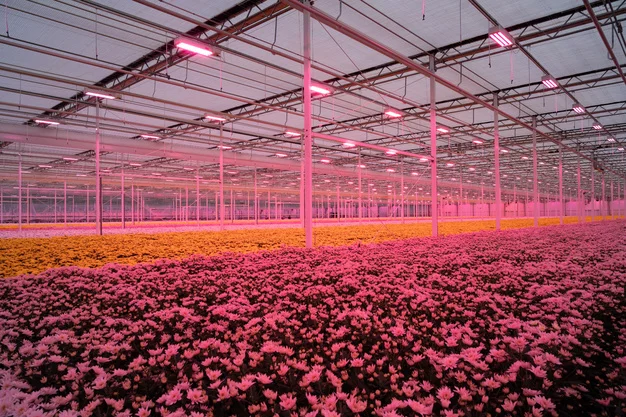
You can see how this works in practice in Project Red Harvest, and learn more about our approach on the DLI website. If you want to evaluate the real cost per µmol of your current installation, contact our team for a tailored lighting assessment.